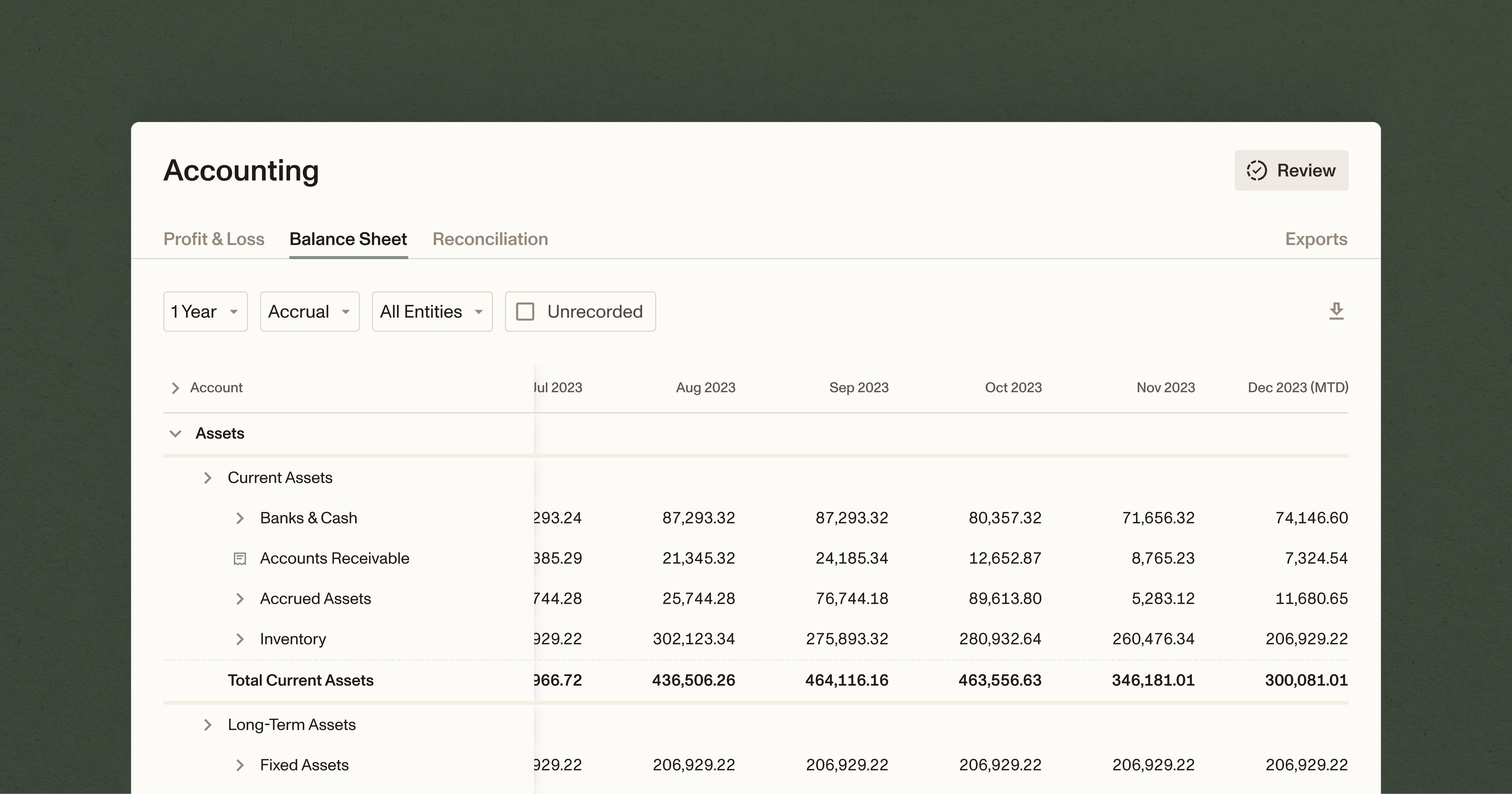
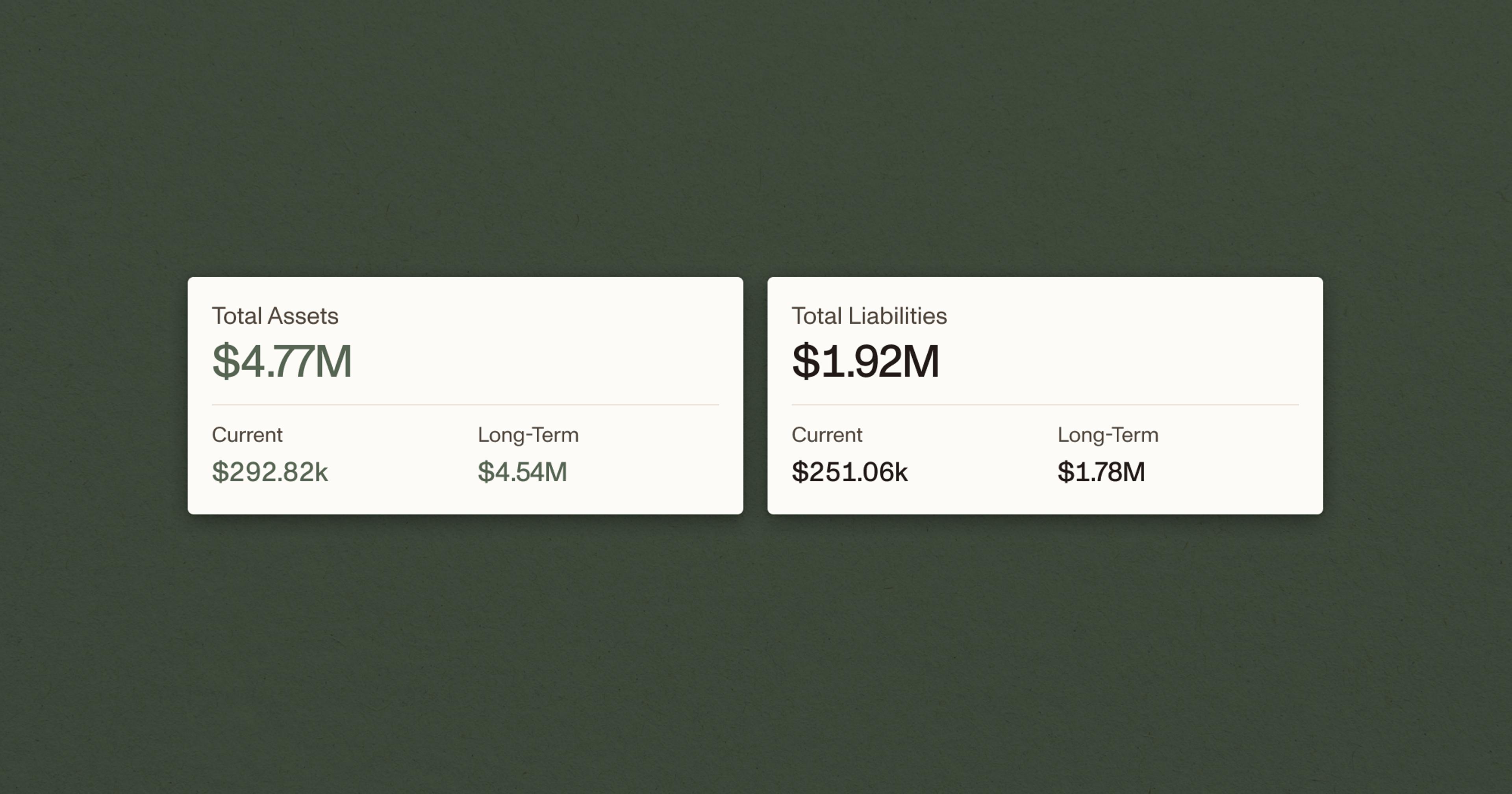
Get valuable insights into your business’s assets, debt, and equity from the balance sheet.
A balance sheet is a snapshot of your business’s assets, liabilities, and equity at a given point in time. In turn, reading your balance sheet means checking what your business currently owns, what it owes, and what it’s worth.
Balance sheets are an important financial management tool: They can help you understand how valuable your business is, how much risk and debt you’re carrying, and whether the business has enough of a financial cushion to continue operating in the future. But if you’ve never seen one before, it can be difficult to read and interpret.
Here we’ll walk you through everything you need to know about reading, analyzing, and getting the most out of the balance sheet.
Key takeaways
A balance sheet shows a business’s assets, liabilities, and equity at a specific point in time.
You can make sure your balance sheet is accurate by checking that the totals add up as expected: Assets = Liabilities + Equity.
Working capital and the current ratio are two numbers that show you how liquid your business is right now, i.e., whether it has enough short-term assets to cover its short-term debts.
The debt-to-asset, equity-to-asset, and debt-to-equity ratios measure your business’s solvency, i.e., whether it can continue operating in the long term.
Remember that a balance sheet is a snapshot in time, not a representation of growth or change over a period.
What is a balance sheet?
The balance sheet is more than just a checkbox on a loan application. It provides a valuable snapshot of a business’s financial position and health at a given point in time.
With a few simple calculations, a balance sheet can tell you your net worth, your ability to stay in business in the short and long term, and whether you might be carrying too much debt.
Knowing that your business has enough working capital to weather periods of uncertainty isn’t just financially prudent. It can also remove a big layer of stress from your day-to-day work; that peace of mind in itself is valuable for many business owners.
Basic balance sheet terminology
Here’s a quick overview of what you can expect to find on a balance sheet:
1. Current and long-term assets
A business’s assets include anything of value that a business owns and uses to produce the goods and services it sells. A business’s most liquid assets are referred to as current assets, or assets that can be converted to cash in a year or less. Assets you don’t expect to convert to cash or liquidate within the next year are referred to as “fixed” or “long-term” assets.
2. Current and long-term liabilities
Any debts a business owes, like accounts payable or loan balances owed to creditors, are included under the liabilities section of a balance sheet. Current liabilities are debts that are due in the next 12 months, while long-term liabilities are debts that are due in more than 12 months.
3. Equity
Equity is what’s left over when you subtract total liabilities from total assets. In theory, it represents the part of the business that you have a claim on, rather than your creditors.
How to read a balance sheet in 5 steps
Before we take a look at a detailed example, here’s a quick overview of the steps to understanding your business’s balance sheet.
1. Check the date and basis
A balance sheet is a snapshot of your business’s value at one point in time, so first, you’ll want to find the “as-of” date or the date that the balance sheet was calculated.
Then, confirm whether it was calculated on a cash or accrual basis. In accounting software like Ambrook, you can typically choose the accounting basis for your balance sheet.
2. Confirm that it balances
Next, take a look at the totals for assets, liabilities, and equity. Do they balance out to this equation?
Assets = Liabilities + Equity
If not, something might be missing or misrecorded. You’ll want to go back to your books and find out what happened.
3. Check the assets
Assets are usually listed by their liquidity. First you’ll see cash on hand and accounts receivable, then you’ll see your inventory (like feed or livestock). After that, you’ll see your long-term assets like equipment, buildings, and land. Check that all your assets are represented in this section.
4. Check the liabilities
After assets comes liabilities. Current liabilities (what’s due in the next 12 months) are listed separately from long-term liabilities (what’s due in more than 12 months). Check that all the liabilities you know of are showing up here.
5. Check the equity and calculate ratios
Finally, at the bottom, equity shows you how much of the business belongs to you or other owners.
Once you’ve checked that all your assets, liabilities, and equity are listed correctly in the balance sheet, there are a few numbers you can calculate for a better understanding of where your business currently stands:
Working capital
Current ratio
Debt-to-asset ratio
Debt-to-equity ratio
Equity-to-asset ratio
In the next section, we’ll use an example to explain what those numbers measure and tell you about your operation.
Example: Reading Ambrook Farm’s balance sheet
To see what a balance sheet can tell us about a business, let’s look at the December 31, 2026 balance sheet for a fictional business called the Ambrook Farm:
Reference our balance sheet example

Here are the totals on Ambrook Farm’s balance sheet:
| Line item | Amount |
|---|---|
| Current assets | $73,885 |
| Long-term assets | $1,052,650 |
| Total assets | $1,126,535 |
| Current liabilities | $30,125 |
| Long-term liabilities | $425,000 |
| Total liabilities | $455,125 |
| Owner’s equity | $671,410 |
Using this balance sheet, let’s ask three important questions about Ambrook Farm:
How much equity is in the business?
How liquid is the business?
How solvent is the business?
How much equity is in the business?
Equity, also referred to as the “owner’s equity” or “book value,” is simply what’s left over after you’ve subtracted all of a business’s total liabilities from their total assets.
Ambrook Farm’s assets total $1,126,535, and its liabilities total $455,125. If we substitute those values into the accounting equation:
Assets - Liabilities = Equity
We get:
$1,126,535 - $455,125 = $671,410According to this balance sheet, Ambrook Farm has $671,410 in owner’s equity.
On some balance sheets, you might also see “retained earnings” listed under equity. This refers to all of the net income your business earned and didn’t pay out in the form of an owner’s draw, cash, or stock dividends. If you have an income statement for your business and the retained earnings from your previous accounting period ready, you can calculate retained earnings for the current period using the following equation:
Current RE = Previous RE + Net Income (or Loss) - Cash Dividends - Stock Dividends
How liquid is the business?
Another important question a balance sheet can answer is how liquid a business is, or whether it has enough short-term assets to cover its short-term debts. Another way to think about this is: could the business pay its bills due in the next 12 months?
To answer this question, we calculate the business’s working capital, which is just the difference between its current assets and its current liabilities, or:
Current Assets - Current Liabilities = Working Capital
Substituting the values from Ambrook Farm’s balance sheet in, we get:
$73,885 - $30,125 = $43,760Ambrook Farm has $43,760 in working capital, which means that it has enough current assets to cover the debts it owes in the next 12 months.
Another important liquidity measure is the current ratio, which is the ratio between a business’s current assets and current liabilities, or:
Current Assets / Current Liabilities = Current Ratio
Substituting the values from Ambrook Farm’s balance sheet in, we get:
$73,885 / $30,125 = 2.453According to the University of Minnesota’s Farm Financial Scorecard, a current ratio above 2.0 is strong, indicating that a business has more than enough assets to cover its short-term liabilities for the year. A current ratio below 1.3 is vulnerable, while a ratio below 1.0 means that a business doesn’t have enough current assets to cover its current liabilities and might soon run into liquidity problems.
Ambrook Farm’s current ratio of 2.453 means that it’s in pretty good shape. It has enough current assets to cover its current liabilities in the next 12 months.
Keep in mind that the ratios we’re discussing here are highly specific to each industry. Businesses in capital-intensive industries like farming, construction, and trucking tend to carry more debt to finance investments in infrastructure, equipment, and real estate, while businesses in less capital-intensive industries like services tend to carry less.
How solvent is the business?
A business’s solvency is all about whether it can continue operating in the long term, and we measure it by calculating its debt-to-asset ratio, or:
Total Liabilities / Total Assets = Debt-to-Asset Ratio
Substituting the values from Ambrook Farm’s balance sheet in, we get:
$455,125 / $1,126,535 = 0.404 or 40.4%According to the Farm Financial Scorecard, a debt-to-asset ratio below 30% is considered strong for an agricultural business, and a ratio above 60% is vulnerable. Ambrook Farm’s debt-to-asset ratio of 40.4% is in the caution range.
How much debt is too much debt?
It depends on the nature of your business and your appetite for risk. Debt is one of the biggest sources of risk in a business, besides changes in income.
If you value growth and expansion at all costs, you might put up with a higher amount of risk. If you value peace of mind, you might put up with a lower rate of growth in exchange for a lower probability of big losses resulting from too much debt.
Other important balance sheet calculations
Another important ratio is the debt-to-equity ratio, which tells us how leveraged the business is, or how reliant on debt it is. The formula for the debt-to-equity ratio is:
Total Liabilities / Equity = Debt-to-Equity Ratio
Substituting the values from Ambrook Farm’s balance sheet in, we get:
$455,125 / $671,410 = 0.678 or 67.8%This means that Ambrook Farm has about 68 cents of debt for every dollar of equity it has. The University of Minnesota’s scorecard considers a debt-to-equity ratio below 0.43 as strong and a ratio above 1.5 as risky.
Another important ratio is the equity-to-asset ratio, which tells us how much of a business’s assets actually belong to the owner:
Equity / Total Assets = Equity-to-Asset Ratio
Substituting the values from Ambrook Farm’s balance sheet in, we get:
$671,410 / $1,126,535 = 0.6 or 60%According to the Farm Financial Scorecard, an equity-to-asset ratio above 70% is strong, while a ratio below 40% is weak. At 60%, Ambrook Farm’s equity-to-asset ratio is in the mid-range.
Frequently asked questions (FAQs) about reading a balance sheet
Let’s review the key components of a balance sheet, and how to understand each section and line.
What are the three parts of a balance sheet?
For a given point in time, a business’s balance sheet shows:
Assets (what the business owns)
Liabilities (what the business owes)
Equity (what belongs to the owners)
A balance sheet typically lists them in that order: assets, then liabilities, then equity.
What should I look at first on a balance sheet?
First, check the date of the balance sheet and confirm the accounting basis it was calculated on. Then, take a look at the totals for assets, liabilities, and equity, and confirm that they add up according to this equation:
Assets = Liabilities + Equity
What’s a good current ratio for a business?
The University of Minnesota’s financial scorecard for farms considers a current ratio above 2.0 to be strong and a ratio below 1.3 to be vulnerable. If a business is coming in under 1.0, it means the business’s current liabilities exceed its current assets.
What’s a good debt-to-asset ratio?
According to the same financial scorecard from the University of Minnesota, a debt-to-asset ratio below 30% is strong while a ratio above 60% is vulnerable.
What’s the difference between a balance sheet and an income statement?
A balance sheet shows what your business owns, owes, and is worth at one point in time. An income statement, on the other hand, shows a business’s revenue, expenses, and profit over a period of time.
Why doesn’t my balance sheet balance?
If you’re checking your balance sheet and you notice it doesn’t balance (for example, liabilities and equity together aren’t adding up to assets), it could mean there’s an error in your books, like a missing transaction. You can try running a trial balance to help you find the error.
Does my balance sheet change if I use cash vs. accrual accounting?
Yes, it does. A cash-basis balance sheet generally won’t show items like accounts receivable or accounts payable, because they represent money you’re owed but haven’t received yet or money you owe but haven’t paid out yet. An accrual-basis balance sheet does show your AR/AP.
How often should I review my balance sheet?
Many business owners will review their balance sheet at least once as they clean up the books at the end of the year, or before they meet with bankers or lenders. That said, it’s a good idea to regularly keep your balance sheet up to date; this helps you see where your business stands throughout the year.
Accounting software like Ambrook can make this easier by helping you generate a balance sheet from the assets, liabilities, equity, and balance sheet transactions you enter into the system.
Ambrook keeps your balance sheet current
Ambrook builds your balance sheet from your books, so it’s ready to go whenever you need to take it to the bank or to the lender. Review it on a cash or accrual basis, export a PDF or CSV version, and invite your accountant to view it directly in the books with you.
Want to see how Ambrook keeps your balance sheet current? Explore the interactive demo below or try Ambrook for free.
This resource is provided for general informational purposes only. It does not constitute professional tax, legal, or accounting advice. The information may not apply to your specific situation. Please consult a qualified tax or financial professional about your individual circumstances.